
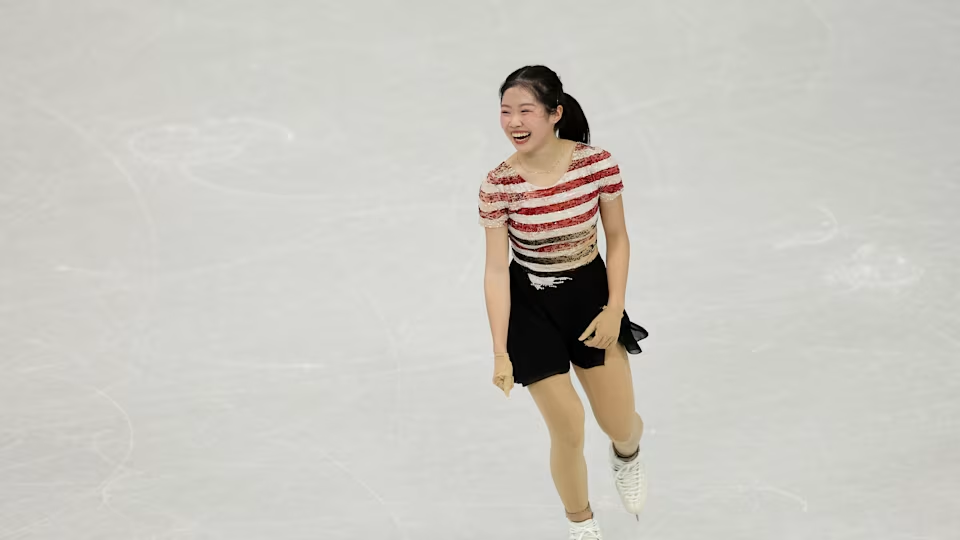
2026 Winter Olympics Women’s Single Skating Free Skating: Ice, Fire, and Pure Magic
When the spotlight hits the ice at the 2026 Winter Olympics women’s single skating free skating, expect chills—literal and emotional. This isn’t just a competition. It’s poetry on blades. It’s power wrapped in sequins. It’s the moment where dreams either soar like a triple Axel… or crash like a missed landing.
So, what makes the women’s free skate at the 2026 Winter Olympics so electrifying? Let’s glide right in.
A Grand Stage in Milan-Cortina
The 2026 Winter Games will take place in Milan and Cortina d’Ampezzo—two stunning Italian cities blending fashion, history, and alpine beauty. And honestly? That’s the perfect backdrop for figure skating.
Women’s single skating free skating will be one of the headline events. Why? Because this is where the medals are decided. The short program sets the stage, but the free skate writes the ending.
Think of it like the final act of a blockbuster movie. This is where everything explodes—in the best way possible.
What Is Women’s Single Skating Free Skating?
If you’re new to figure skating, let’s break it down simply.
Women compete in two segments:
- Short Program
- Free Skating (also called the Free Skate)
The free skate is longer—about four minutes—and gives skaters more room to show off technical skills and artistry. More jumps. More spins. More choreography. More drama.
It’s not just about landing jumps. It’s about telling a story on ice. You’re not watching an athlete—you’re watching a performer, a storyteller, and a warrior all at once.
How the Scoring System Works
Let’s talk points—because at the Olympics, every decimal matters.
The International Judging System (IJS) scores skaters in two main ways:
1. Technical Elements Score (TES)
This includes:
- Triple and quadruple jumps
- Combinations (like triple-triple)
- Spins
- Step sequences
Each move has a base value. Judges then add or subtract points based on execution (Grade of Execution, or GOE). Clean landings? Big points. Wobbles? Not so much.
2. Program Components Score (PCS)
This measures:
- Skating skills
- Transitions
- Performance
- Composition
- Interpretation of music
In simple terms: Did it move you? Did it flow? Did it feel effortless?
The final score is a mix of athletic precision and artistic brilliance. It’s math meets magic.
The Evolution of Women’s Figure Skating
Women’s single skating has evolved at lightning speed. Not long ago, a triple jump was enough to dominate. Now? Skaters are attempting quadruple jumps and ultra-difficult combinations.
Stars like Kamila Valieva and Kaori Sakamoto have pushed boundaries in recent years. They’ve raised the bar so high it almost touches the arena ceiling.
By 2026, expect even more technical firepower. Younger skaters are training quads earlier. The sport isn’t just evolving—it’s accelerating.
It’s like upgrading from a sports car to a rocket.
Key Elements to Watch in 2026
If you’re watching the free skate in 2026, keep your eyes on these:
Quadruple Jumps
These are game-changers. A clean quad can swing the medal standings instantly. But they’re risky. One small error and—boom—points vanish.
Triple Axel
One of the hardest jumps in women’s skating. When landed cleanly, it’s breathtaking.
Choreographic Sequences
This is where personality shines. Some skaters float like swans. Others attack the ice like warriors.
Stamina
Four minutes of intense performance isn’t easy. Fatigue shows in the final jumps. Champions finish strong—even when their legs feel like jelly.
The Mental Battle on Olympic Ice
Here’s something we don’t talk about enough: pressure.
The Olympics come once every four years. For many skaters, this is their only shot. Imagine training your entire life for one four-minute performance.
No retakes. No second chances.
The roar of the crowd. The cameras. The judges. The expectations.
It’s like walking a tightrope above the world.
The women who medal in 2026 won’t just be physically strong—they’ll be mentally unshakeable.
Rivalries That Could Define 2026
Every Olympics needs a storyline. In 2026, we may see fierce rivalries between rising stars from Japan, South Korea, the United States, and Europe.
Countries like:
- Japan
- United States
- South Korea
have invested heavily in figure skating development.
The competition will likely be razor-thin. We’re talking about differences of less than a point deciding gold.
That’s the beauty—and heartbreak—of Olympic skating.
Why the Free Skate Matters Most
Let’s be real. The short program sets the tone, but the free skate decides history.
A skater can recover from a weak short program with a flawless free skate. We’ve seen it happen before. One perfect night can rewrite the leaderboard.
The free skate is longer, riskier, and more emotional. It’s where courage lives.
And when a skater nails every jump, hits every musical accent, and strikes that final pose? The arena explodes.
That’s the moment you remember forever.
Fashion, Music, and Storytelling on Ice
It’s not just about jumps.
Costumes in 2026 will be bold, dramatic, and expressive. Music choices will range from classical masterpieces to modern cinematic scores.
Some skaters will choose emotional ballads. Others will skate to intense, powerful soundtracks.
Each performance becomes a mini-movie. Four minutes. Beginning. Middle. End.
And you? You’re hooked.
Predictions for the 2026 Women’s Free Skate
So what can we expect?
- More quadruple attempts than ever before
- Higher technical base values
- Younger competitors entering the Olympic spotlight
- Programs blending athleticism with deeper storytelling
The gold medal performance will likely require both technical firepower and artistic maturity. It won’t be enough to just jump high—you’ll need to connect emotionally.
In 2026, the champion will be the skater who balances risk and grace like a master tightrope walker.
Why You Shouldn’t Miss It
Even if you’re not a die-hard skating fan, the 2026 Winter Olympics women’s single skating free skating is must-watch television.
Why?
Because it’s unpredictable.
Because it’s emotional.
Because it’s human.
One second, a skater is flying through the air. The next, she’s fighting to stay upright. It’s raw. It’s real.
And when someone delivers the skate of her life? It gives you goosebumps.
Conclusion: Four Minutes That Define a Lifetime
The 2026 Winter Olympics women’s single skating free skating won’t just crown a champion—it will create a legacy. In four intense minutes, years of sacrifice, sweat, and silent early-morning practices will either shine like gold… or melt away.
That’s the magic of Olympic figure skating.
It’s not just about medals. It’s about courage under pressure. Art under fire. Beauty in motion.
So when the music starts in Milan-Cortina, don’t blink. Because history on ice moves fast—and you won’t want to miss a single second.